Showing posts with label 6V6 tube. Show all posts

Monday, November 29, 2021

1965 Fender Vibro Champ Amp, low volume, What are some people thinking when they mod an amp????


This was a repair amongst many I did for Southside Guitars last month over a marathon 2 day period. Simple amp, somehow it took up more bench time than the rest!


You're looking at a run of the mill used 1965 "Fender Electric Instrument Company" pre-CBS Vibro Champ. Lovely little buggers. The first time I ever played one was at this guys apartment in the 80's in Boston. He used a TS9 Tube Screamer into it to record my guitar tracks when I was a Berklee student. I was pretty floored at how good it sounded. I think he had a reel to reel or one of those cassette 4 track machines we all had in those days, the Fostex X15 or Tascam something or another. 


Anyway. This one had very little volume. I popped the chassis and, well, you tell me what you see:


Yeah. Seriously. What the eff? That nice bit of lamp cord poorly soldered between the input of the volume knob directly to the 15k midrange resistor which goes to ground. So where you want to see up to 250k between you and ground, you get 15k maximum. I just don't understand what they were trying to achieve here! Did they put it together and say "Yeah, now that's the ticket to Hollywood baby?" 

Why didn't they just undo it? Ugh......

That was the first thing to take care of and while it helped tremendously, there were plenty of other bugs.

Always start from the back and go forward. The speaker was an old alnico full range 8 ohm job with a whizzer cone. That wasn't helping any so I just threw in what we had that day, a reissue 4 ohm used Jensen Alnico speaker. That helped but still, meh.... blah.... lackluster. No bass at all.


They had replaced every single signal capacitor with used / leaky weak caps that were also the wrong values. I used Mallory 150s and if you notice, I grounded the amp and used the .047 "Death Cap" at the midrange capacitor cuz, why not? Reduce reuse recycle! And those never go bad and have a special sound. 

I also replaced the tremolo caps with fresh ones as that was super weak and they had some weird stuff going on in there too. 

But still, no bass and pretty sad tremolo.

Cathode caps..... no bass, sad tremolo. Tremolo is just an LFO right? Better have fresh cathode caps to get it strong. In fact, just replace them already! This amp is 56 years old now.

After that I still wasn't happy though. Tremolo was working albeit, just not awesome, and the bass would vanish when you turned the treble up. Weird......

So upon closer inspection I noticed the tremolo intensity pot was dated 1966, but no indication of the ohms. They always say 25K RA. So I pulled it and measured the thing. 500k. WRONG! 

I dropped in a 50k pot since that was all I had on the shelf. Those 25K reverse audio pots are hard to find. The 50k pot isn't correct but it did make the tremolo work better. With the 500k pot there was almost no tremolo until you got up to about 8. So, while not satisfied this would work. I could also bypass it with a 47k resistor to make a fake 25k pot. I don't like doing this but in a pinch it does work and only the rabid amp fanatic can usually tell.

But that treble control bit was really driving me bananas. The amp still seemed weak too. So I then figured if the Bozo that modded this amp changed that tremolo pot to something so wack, maybe they changed a tone pot.

They didn't. The tone pots are the original 250kA pots dated 1965. 

So I checked the volume pot. Lo and behold, it was the 25K RA Intensity pot I needed! Captain "Wha? TechNo No No" used the 25k pot and scrapped the 1Meg pot that was in there. I took that 25kRA pot and put it where it belonged and threw in a new CTS 1 Meg volume pot. 

Now we're cooking with grease...... GREAT tremolo and GREAT tone!

The power transformer was replaced sometime in the 70's with the correct part. I did clean up the wiring there too. Come on folks, twist those AC lines already!!

In conclusion. I do not know what this person was trying to achieve with the mods they did. If they were trying to make the amp play with little volume, why not just turn the volume knob down? I imagine they may have been trying to get more tremolo so they used that 500k pot. Nope! 

If you do not know what you are doing then please consult someone! Otherwise a fella like myself can spend hours undoing your ill conceived ideas. Seriously, ask. Most of us are happy to share information....

J


Wednesday, September 16, 2020

1940's Kalamazoo KEA

 Curious little bargain tube amp that I got to bring back from the dead..... a 1940's Kalamazoo KEA.


This is one circuit that I'll admit I have little idea of how it works. It has a single 6SJ7 driving a pair of 6V6 tubes. How this is achieved I do not know. It's not parallel single ended. Look at the schematic!


The other challenge was finding a 10" speaker that is shallow enough to fit in such a tight space. This project sat around and almost made the 'sold for parts as-is' pile. Nothing fit! But fortunately I was able to find an old CTS speaker in the bowels of Southside Guitars deep in the basement under discarded case parts...... It was dead so we had it re-coned. Speaker had the perfect holes to mount the output trasformer.


In the end it's a fantastic little amp. Not a fuzz box, very clear and defined. These are financially not worth the effort, you'll likely lose money doing what I did. But we were all so blown away by it's charming tone that an employee bought it and will be tracking with it! I have an affinity for the 6SJ7 tube. My favorite preamp of all time so it's not surprising how much I like this amp. 


Did the usual, changed the caps etc. Fortunately both transformers were good. I do not think this amp would work well without that odd asymmetrical output transformer. So make sure that part is happy before you commit to one of these. 


J


1947 Fender Model 26 "Woody" amp

 I thought I'd share about this one.... very rare bird indeed. A Fender Model 26 "Woody" circa 1947.


This came through Southside Guitars with the matching lapsteel. Unfortunately both transformers were destroyed. The good thing is I managed to buy some period correct NOS iron that worked perfectly. I don't think one needs to be too precious in what iron one uses as I believe Fender used what was available in these early days. I could be wrong about that but either way the amp turned out to be fantastic sounding.


I needed to replace every capacitor in the house and some resistors. Curiously rather than using a 250 ohm 5 or 10 watt resistor for the cathode bias circuit, Leo used 2 500 2 watt ohm resistors going from pin 8 to ground with a wire connecting the two with a single 25@25 volt cap on the board. I replaced those with some pretty NOS 500 ohm 5 watt wire wound resistors. 


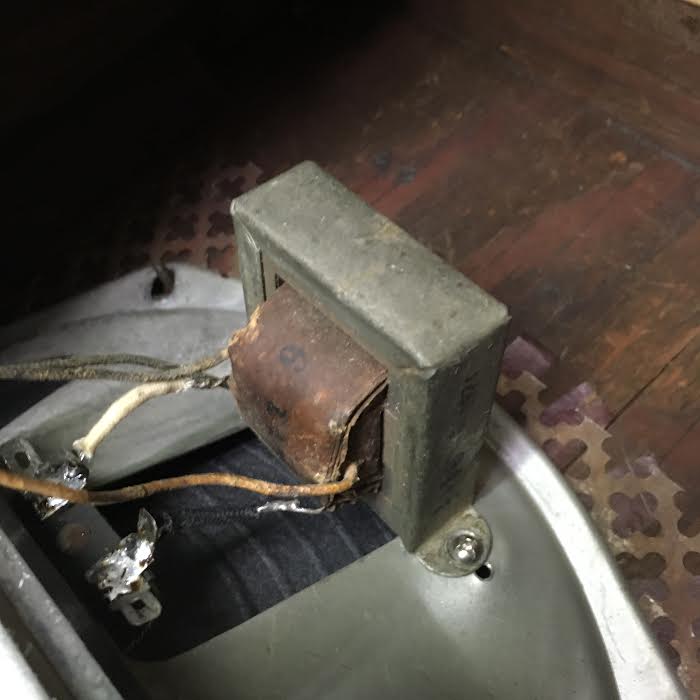
The speaker was shot but original so I had it re-coned. Always the best choice I feel, especially with these. There is no place to mount the output transformer except on the speaker. Worked out nicely!


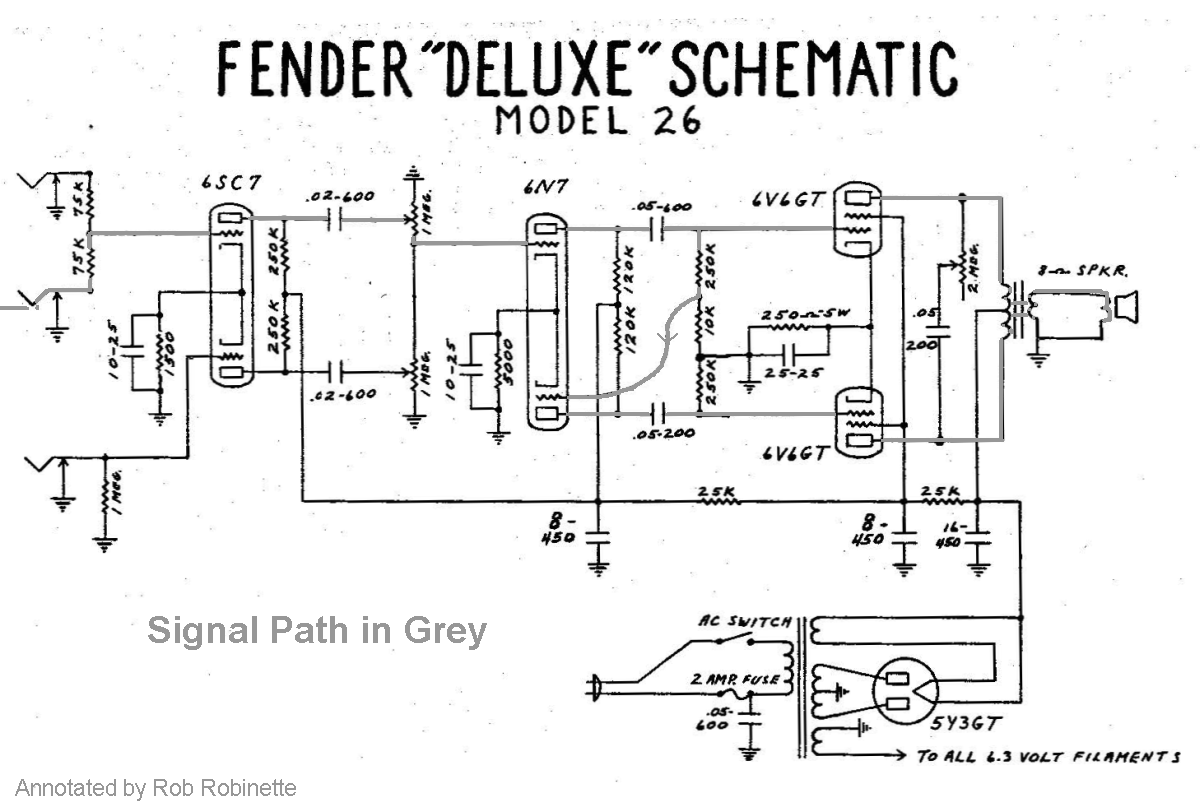
One peculiarity with this amp is the tone control. It's the worst I've ever seen. It's a 2 meg pot and a .05 capacitor going across the anodes of the 6V6 tubes. Oh, it worked, very dark, turn the pot then like a switch it's full on. That goofy taper doesn't actually bug me but what does is when you blast the amp you can see sparks inside the pot! I asked the owner if I can wire it somewhere else in the circuit, like a normal tone control. Better to not have an amp flame up. It's fine at moderate volume but who wants that with a little scream box like this????

I can say this amp sounds incredible. Very colorful, very rich and quite loud. More "primitive" than a later Deluxe and has a focused sound with that 10" Jensen speaker. 


One that is worth building if you are into that sort of thing. Experiment with that tone control I say!


Schematic:


Old school construction!!!! :


Original Jensen dated 1946.....


Tuesday, August 22, 2017

Bad Cat 5R, adding a tube rectifier and making it sing like a bird

So a client of mine has this amp for his office use. It's a Bad Cat 5R. Don't know much about them but have heard they are related somehow to Matchless. This is my first venture into a Bad Cat and having worked on many Matchless amps I can say they certainly are similar.

The job: Modify the crap out of this amp!


My client has recently become hooked on old amps, Marshall, Tweed Fender, Supro, 50's Gibson, Ampeg. This amp just isn't doing it for him any longer. It's stiff and rather dull.

Now, it's a very simple circuit with only 2 tubes. A 6V6 driven by (interesting choice that I like!) a 6SL7. There is only so much modifying one can do. When I fired it up the first thing I noticed was what a lack of distortion there was. I like my little amps, distortion (Gibson GA5 from the 50's) or no distortion (Magnatone Varsity) to have a warm singing quality to them. My client is into warmth more than over the top blast so the goal is to get it to do both. I found the amp to lack warmth.

I have a back to front approach with amps whether I'm trouble shooting or modifying. Example: first thing to look at with a dead or dull sounding amp is the speaker and/or the power supply. So I started there. First thing: Why use a Celestion Vintage 30 on a 5 watt amp? If you want to go for cleaner tones that's great and I'm not objecting their speaker choice, it's purely subjective. But for this project we went with a 20 watt Weber 12A125A the one that says "woody and reedy".

https://www.tedweber.com/12a125-a

I love this speaker. My favorite amp that I built uses a 30 watt version. A bit on the darker/warmer side of the spectrum, nice smooth breakup.

The second thing is the power supply. Stock it uses 2 1N4007 diodes loading into a 100uf 450V capacitor. I decided if it's an easy fix to add a tube rectifier let's go for it. I like my little amps to compress! You can see diodes right under that blue power resistor.


So once I looked around I noticed 2 things right away that made me happy. Chassis is pre-punched for more octal sockets and there are 2 yellow wires coming off the power transformer. That means there is a 5 volt filament tap! YES! This job just got easier.

So I took out the plastic socket plug and installed a socket. Removed the 2 diodes, put the red wires to pins 4&6, the yellow to pins 2&8 and replaced the 100uf with a 47uf cap. Why replace that cap? The 5 volt filament line is at risk with anything too high. With diodes the sky is the limit, but with a tube rectifier you don't want to go too much above 50uf.


I opted to use a 5V4 for the rectifier. For squishiest results go with a 5Y3. I figured this would be a dramatic shift as is and didn't care to go too dramatic. Fun thing is, they are interchangeable and my client likes to fiddle with tubes.

The circuit itself:


I won't go too much into detail on the circuit mods cause I encourage you to use your own creativity. What I did start with was the cathode resistor on the output tube. It's a 270 ohm. I replaced it with a 500 ohm. It's just more loose. I also replaced all those horrible brick drop polypropylene caps with warmer sounding Mojo Dijon caps and any resistors in the signal path with carbon composition. Also the first gain stage cathode cap is a 6.8k. I just copied Fender and used a 1.5k bypassed by a 22uf cap. The whole amp seemed to come to life in a good vintage fun way.

So now this amp sings at any volume. It has a master volume which didn't really serve too much of a purpose before but now you can bring it down and blast the preamp. With my S.G. it's like a mini AC/DC concert.

I think these are good amps even stock. Very well made and built to last. The reverb is transistor driven but that doesn't offend me, it's quiet and sounds nice. But if you aren't opposed to making your Bad Cat a Badder Cat, try some of these fun mods, use your creativity and you can tailor it to suit your needs.

Disclaimer: if you are a novice, don't try this at home. Pay someone like me to do this kind of work. Tube amps are no joke inside, they can kill you with the amount of juice running around in there! So tell your favorite tech what you hear in your head and let the magician work his or her magic.

Thanks! JB

Sunday, December 25, 2016

1954 Fender Princeton 5C2 amp. Lovely warm jazzy sound.


Here's an interesting amp. A 1954 5C2 Wide Panel tweed Fender Princeton.

This was an internet purchase what was serviced by the previous owner. I didn't take any before pictures but, the amp worked fine but the work was comically sloppy. I get a lot of work cleaning up poor jobs.

The other bits: this is a really great amp. It was loaded with a cheap Electro Harmonix 4 ohm speaker and a cheap Triode Electronics output transformer. Not bad stuff, but to my ears, it was rather flat and uninteresting. It was also loaded with Sprague Orange Drop 715 caps. No, no, no. Filter caps were decent quality but sloppily installed.

So I loaded it with Mojo Dijon caps, a 60's 8 ohm Jensen C8R (I effing love these speakers!) and a Mercury Magnetics '55 8 ohm tweed Princeton transformer.

C8R: Brown is Beautiful!!!


I come across these speakers on EBay all the time. Best lil' secret though I suppose if I get more readers everyone will want one. Not useful for Champs, these are 8 ohms. But for my GA-5 and old Magnatone Varsity, it's a match made in heaven. They were often used in organs as midrange drivers so they are usually in great shape. People played polka and church music through these babies, not blues and rock n roll!

Yes I know it's not an alnico speaker. I do love a good alnico but as someone who plays out live on tiny amps, I like the way these project and hold together. I like the clarity I get. Try one! Couldn't hurt!!!


Better interior though not final:


I replaced the original 250k 2 watt load resistors which were noisy with new carbon composition 2 watters. Also replaced the cathode bias resistor and power resistors, typically they drift far out over time and these were no exception.

This particular amp has one transitional feature. They were loaded with a 6SC7 tube, then a 6SL7. In this amp the socket had an adapter to put in a 9 pin miniature socket so it could be loaded with the more modern 12AX7. This was factory. And not unusual is the tube chart simply has the 6SL7 tube crossed out with a ball point pen and 12AX7 written in. Leo Fender liked to use whatever parts he had left over till they were gone. Very much in line with his practical sensibilities.


I took out the "meh" output transformer and loaded it with a classy Mercury Magnetics FTPO-55-8. From my research on these amps, they were 8 ohms. Better to not be lazy and use your off the shelf 4 ohm Champ transformer if you are going to get this right. Just my opinion. More expensive, yes, but totally worth it. The amp came to life after installing this and the Jensen speaker. Big, warm and round. I fell in love with it right away. With a Les Paul or a big Jazz Box it's heaven.


The Mercury transformer is bigger than what was in there, and I suspect the original may have been mounted to the speaker. But the good thing, there are some factory 'mystery' holes in the chassis that mounted diagonally the transformer mounted perfectly.

These are quite different than the more sought after late 50's 5F2 model. This one is a 5C2.


The preamp arrangement is radically different than a 5F2 or 5E2. Between the first and second stage in the preamp you have a 250k resistor connected to a 75k resistor that is going to ground. It's a bit like having a potentiometer in that spot and it's set to 1/4 volume. Just for fun I tried opening this up to see if I could get more gain. The amp simply became unstable and started motorboating. BUMP BUMP BUMP BUMP.......  I put the resistors back the way they were. Looking at the schematic this may work with an additional stage to the power supply, this sound typically happens when you have a bad filter cap or too little filtering. Could go to all that trouble or...simply accept this is the way this amp is and what it is is not a later one. Why not have an amp that plays cleaner? It has such a beautiful tone. For my style, it's perfect and I kind of want to build one just for me.

You can see the evolution in this amp going from the old 6SJ7 circuit, which has little gain, to the later rock n roll nasty later 50's 12AX7 version. It sits right in the middle of that evolution. The tone is more relaxed than a later version, but has a bit more punch than the earlier version. Right now the owner claims it's his favorite. I can see having one and feeling the same way. Great little rare gem!

JB