Wednesday, February 3, 2016

1967 Fender Bassman amp


  Here's an amp I used to see all the time and haven't seen much of in a while. A good old '67 Bassman head built by Fender in Santa Ana California. These are to me some of the most consistently good sounding amps built by Fender, and are still relatively a bargain when compared to the earlier black panel amps. These are commonly known as the 'drip edge' series due to the aluminum edge around the grill cloth.

  This one is an AB-165 circuit. They started building this right around 1965. Not as desirable as the earlier AA-864 which, I ain't gonna lie here, is a better sounding amp. But these aren't bad by any stretch of the imagination. The AA-864 is relatively hard to find. I would describe it as more open sounding, the classic 'black panel' sound. These do have a bit more of a stuffy sound to them. You can convert one of these, it's a pretty big task so I wouldn't attempt it unless you have some serious skills. I've done several over the years with satisfying results. There is one thing I don't see talked about in literature and that is the output transformer may be wired out of phase on the AA-165. Once you do a conversion when you fire it up if it sounds like Armageddon (bombs falling, explosions, people screaming!!!) simply switch the blue and brown anode wires on pin 3 of your 6L6 tubes. Seriously, it's a scary sound!

  This amp just needed service. It had been off for about 25 years in storage. 5 out of the 6 tubes were original to the amp and unfortunately the 6L6 RCA tubes were shot. Always sad to see those go. I replaced them with Sovtek 5881 tubes, the thin base ones. They are rugged and sound decent. I like them the best cause I never get returns. All other glass is risky. The 12AT7 phase inverter tube I replaced with a NOS Sylvania. There are plenty of NOS 12AT7 tubes around, and in a Fender amp these, especially in the reverb driver circuit, take a lot of abuse. I get annoyed when I see new glass in these positions. The JJs and Sovteks fail. Don't be cheap and don't be lazy and besides, these often COST LESS than new glass. If you don't need premium Telefunken or Mullard, any garden variety RCA, Sylvania or G.E. will do.

  This amp received a full re-cap. Get those old, crusty electrolytics out of there! Yeah, they look cool and have those date stamps but, they need to go.


  Also check the power supply resistors. These were okay so I left them. Always replace the screen grid resistors though.

  I didn't convert this amp but did convert the bias supply. This is the era where Fender started to be more concerned with balancing the output tubes than actually biasing the amp properly. One tube stays constant, the other is adjustable. Not a terrible idea, Marantz has an individual bias pot for each tube, I like that. To do this really right you would need to add another pot to adjust overall bias, but we're just going to make it like the older amps.


  Now, on a late 70's model you need to leave that balance pot alone and add a bias trim pot. Here's why. Those amps are Ultra Linear. When one side drifts out the amp hums. I've seen people pay for a re-cap on one of those when all it was is the poor tubes aren't matched up right. I'm not a fan of ultra linear output transformers in guitar amps. The idea is low triode distortion at high pentode power. The result is an amp that is good for pedal steel or jazz but not as likable as the previous models.

 So Jef, what is Ultra Linear???

  Read this:   https://en.wikipedia.org/wiki/Ultra-linear

  https://www.ampbooks.com/mobile/amp-technology/ultralinear/


The Marshall Major, Park 150, Sunn amps, these are all Ultra Linear. I like these for bass. For guitar I like my distortion thank you!

  Anyway back to our Bassman. Once I got the amp re-capped and biased the amp ceased to hum and sounded great but still more needed to be done. Snap, crackle pop, hiss....... Here's an example of a big corporation trying to squeeze out every profit they can. Leo Fender was a perfectionist. He chose the best components available to him be it pickup wire or resistors, you know, the little things. CBS decided to buy resistors from Joe's Discount Resistor Shack, they probably just got a better deal on them. It's not unusual to have to replace EVERY load resistor in one of these along with the 220k and 470K resistors in that additional gain stage. Check them. In this amp all of them had drifted way out of tolerance. I replace them with new carbon composition resistors to retain that old, warm sound. There are plenty of choices. You can go with new Allen Bradley or Nichicon, Kemet, they are all good and I'm grateful I can buy these at Mouser, Antique Electronic or Mojo Musical. When I first got in the game I had to scour dirty, disgusting and often depressing HamFest or some poorly lit electronic supply houses. Ok, I did enjoy the HamFest and the surplus places, many of which are now gone were pretty special places. You met some really eccentric folks there. But that's ironic progress for you. A demand for a resistor that is by all means antique has created a new supply for us with picky ears! And that's exciting.

  It's the little things....

JB

Tuesday, December 1, 2015

'65 Deluxe Reverb Re-issue. This offends me!


 Today we have what I consider to be one of the best values on the marketplace today: a good ol' Fender '65 Deluxe Reverb reissue. Classic design, perfect club amp for those who like the black panel Fender sound. 22 watts of power through a pair of 6V6 tubes. There was a time when if I had a dozen original ones in my store they would be gone in a month. Everyone seemed to want one about 15 years ago. Now the watts war is in reverse and that honor goes to the Princeton Reverb. Those sell effortlessly enough that Fender made a re-issue of those as well. I prefer the Deluxe myself.

  So hopefully my headline got your attention. These are great amps but there are a few things about modern construction that just bum me out. This one was dead, no big deal, just had a burnt 6V6 tube. The fuse didn't pop so the 470 ohm 1 watt screen grid resistor burned up. Again, no big deal.

  In the old amps Fender put the 470 ohm screen resistors on the tube sockets along with the 1.5k grid stop resistors. To cut cost they put these on the circuit board. When one burns up, and it is a dramatic burn, it makes a mess. Here is the socket:


And here are the burnt resistors on the board:


So first step is to cut those resistors out and clean up the board with sandpaper and compressed air. Get as much of that carbon out as you can.


  Next I bypass where the old resistors were. I also bypass R60 & R61, the grid stops. I will be moving those to the sockets as well. Why? They should be on the sockets. They don't always work when they aren't. Why risk that? I've seen it happen before, having them on the board doesn't prevent oscillation at high volumes. Simple fix.


  Now admittedly, I'm cutting a corner here too. The proper way to do this is to remove the board and remove the resistors, then replace them with a solid piece of wire. Do as I say, not as I do. This does add time to the job but we are on a budget and this works just fine.

  Here are the re-wired sockets:


  Notice I moved the orange from pin 4 to 6 and put the 470 ohm, now 2 watt resistor between 4 and 6. I also moved the green wire from 5 to 1 and put nice sounding carbon composition 1.5k 1/2 watt resistors between 1 and 5. This is how they did it in the glory days of amp building.

  Now if a tube blows again, there is less mess to clean. I feel better about the whole thing. Not to mention, if we were to put those screen resistors back there they were, the next time they burn, they will burn a whole through the board most likely, then we'll have a real mess! Prevention is easy on these amps. Do this and save yourself trouble down the road!

JB

Monday, November 9, 2015

1959-60 Ampeg M-15! This is a great amp!


Mercury must have been in retrograde and taking its toll on out of date gear. This old Ampeg M-15 showed up a few weeks back. It was blowing fuses. Once againI hoped it was just a dead tube but alas, it was a burnt power transformer. You could smell it!

These early Ampegs are really likable in the sense that they are really well made and use fairly common tubes unlike the later models. This one has 3 6SL7 tubes, a pair of 6L6 tubes in cathode bias and a 5U4 rectifier. All are easily sourced and not terribly expensive.


Here's a shot of the back:


Amp has the original 15" speaker though it was re-coned in 1999. The filter can was replaced in 1994, it's dated. I usually like to replace filters after 20 years but the amp after it was fixed has no hum and a lovely voice.

So first, the transformer replacement. Again I could have purchased an expensive Mercury Magnetics part or Hammond makes a suitable one as well. But we're on a bit of a budget so I used a nice US built part supplied by a company on Ebay. It's slightly smaller but has the 140ma I need to feel good about this job.

So first the burnt out culprit:


Remove it. Unsolder everything first:


The second shot is the rectifier tube socket. The unused pins have the 2 black wires from the power transformer to the wall, 120 VAC. I don't like this arrangement. I doubt it's factory. So I found a solution. Simply put one of the 120 V in wires on the fuse, the other on the power switch. Makes for a tidier amp!

Next measure:


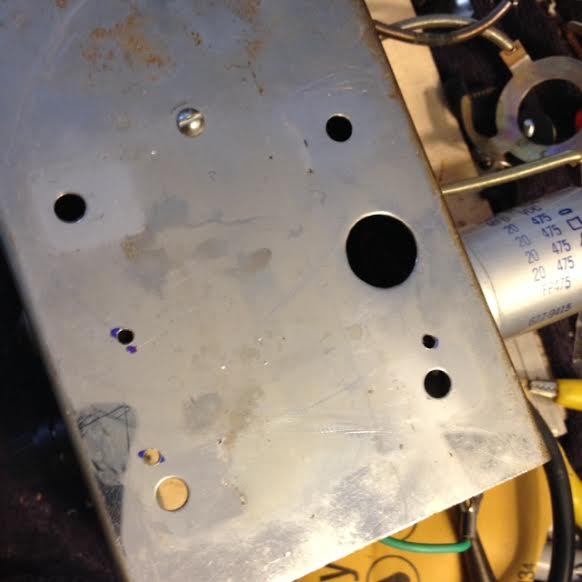
Simple. Use the new part as your guide. The new part has wires coming out both sides whereas the old part only one side. I'll need to drill a hole for that side, hence the blue dot on the left towards the middle.

  Next drill away! Start with 1/8" pilot holes. Use oil on your drill bit if needed.


The big hole I made with a step drill bit. I think I paid about $60 for it and thought I was crazy. But the first job using it the thing paid for itself. No more filing and wasting time!

Once it's in, start wiring it up:


Now before you get your collector panties up in a bunch about drilling a chassis, here's the deal. This is a beat up old Ampeg. They sell for about $450-$750. They're great player amps and you aren't going to hurt the value by making them playable!

So next, put it on the Variac with no tubes in it and see if that pilot light comes on:


Next, drop in that rectifier tube and bring it up slowly again and test the B+, or pin 8 on that 5U4:


Yup. 471 volts. Not for the weak. Don't mess with a tube amp if you like to drink while you work. Can be fatal.

Once I got this amp working another couple issues arose. The tremolo was weak. 3 out of 4 of the tremolo caps were replaced but they were replaced with some real crap. So I replaced all of them along with some other dead caps and cheap craps. I also replaced the tremolo feed resistor (470K on the schematic feeding the intensity knob) with a 220k. It's good to experiment. Too high a value and you have some weak ass tremolo. Too low and you have a 'WOOF WOOF WOOF THUD THUD THUD' sound. And that can actually damage your speaker. I've seen it happen. Rare, but possible!

Here is a beautiful schematic drawn by Joe Piazza. The tremolo circuit is in the lower left corner.


All in all, this is a really great amp. Ampegs have a totally different thing going on that Fender or Gibson. They lack the 'bite' but the mids make up for it. Lovely, warm sound, euphonic. This model had 5 inputs going into 2 channels. Accordion or Instrument. I prefer the bigger and deeper sound of the Accordion channel myself. Makes my Esquire sound bigger than one would expect.

So if you find one of these at a good price, these are a good deal. Like a tweed Pro with tremolo, more interesting of a choice. They are hand wired with a board not unlike a Fender amp. I imagine a pedal steel would be a great fit for this amp. My friend plays her violin and guitar through this amp. Lovely choice for a fiddle! Big and warm, that's what you want!

JB

1978 Marshall JMP 50 watt combo


Yes. That's all I need to say.

These are fantastic amps. This one was blowing the H.T. or high voltage B+ fuse. We had hoped it was one of the 6550 tubes but unfortunately the output transformer was cooked.

When the H.T. fuse pops 9 times out of ten it's just a power tube. Once in a while it's a shorted filter can but every so often it's the output transformer. That makes for an expensive repair. And the sad part is it does tend to hurt the value whether it sounds better or not.


Here's the ultra simple control panel. Gain, Master, EQ and presence. You really don't need any more with an amp that has this much sound. These are known as rock n roll amps but in the right hands can be good with any style. Someone clipped out one of the treble caps, the one on the volume knob. I owned one and clipped out both of them. I don't need that much treble and clipped out you can simply turn up your treble and presence if you need it.

This one has the original speaker intact. A pair of lovely 30 watt "Black Back" Celestion speakers:


So what output transformers do I like these days? I'm a Mercury dealer and I also deal Mojotone as well. For the price you can't beat the Mojo. I believe they are made by Heyboer and they are first class transformers. Friendly right out of the box. The Mercury product is expensive. Very expensive. I like there iron very much but there are only a few things to me that are worth that much more. When I was building amps for people I used their ultra expensive "Radio Spares" iron in a JTM 45 I built and always used their "Radio Spares" output transformers in my 18 Watters. They simply can't be beat in that capacity. I had the pleasure of playing my JTM amp next to a real "coffin logo" '62 model and mine was so close. I sold that amp for about $1300. The '62, granted is ultra rare, but cost around $20,000. So parts makers like Mercury and Heyboer helped me lose my lust for old amps! Why spend all that money if my intent is to enjoy it?

But for general repairs and price, the Mojotone iron can't be beat. I've used many of their transformers with dynamite results. In this Marshall I can say DYN-O-MITE! It's got it where it counts and was a relatively easy install!

JB 

Stereo Memory Man

  It's been a minute since I've written anything so I'm up late catching up.


  Just re-capped this tonight. It was making this wum-wum-wum-wum slow pulsating sound and has been slowly dying over the years. Dead filter caps. Photo after:


Nice thing about modern electrolytics is they are so much smaller than the originals. Just makes everything fit better.

These are lovely sounding units. I prefer them over the "Deluxe" version. They are built like total crap, which is part of the Electro Harmonix vibe. I've heard some that are really noisy, this one after the recap is much better now. If you open one up beware. They use this thin solid core wire that just loves to break. I only lost one and had to look at a schematic to figure out where it went. I also had to open it back up cause of a previous hack job on the delay pot. If you look at the picture you can see it,  the one in back with the blue shaft. It's really difficult to find proper pots for these with the ultra long legs, and 2 of these have been replaced. So people usually cut the old ones out and solder the new pots to the old legs. Not a problem, unless it was poorly soldered like this one! A leg joint simply broke upon re-assembly and the delay speed knob was no longer working. No biggie!

Anyway, here's a schematic.


Fun! It's been on for 3 hours now. No hum! I win!

JB

Monday, October 12, 2015

Sovtek Mig 50 Midget: For Steven Melkisethian.


  Back around 1991 I worked for Angela Instruments in Annapolis Junction Maryland. For those of you who don't know Mr Steve Melkisethian he was perhaps the biggest vintage Marshall dealer in the country who dedicated much of his time scouring the British countryside looking for old English amps and hauling them back to the states. He did the same here much to the jealousy of other vintage dealers. Dude worked harder than anyone and served as a huge inspiration for me teaching me much about old tube amps and how to build new ones as well. At one point he even published a Xerox copy of all his haunts across America (army mess halls where he bought tweed bassman amps they were using for PA systems, pawn shops, crazy collectors etc) that you could buy for $300. Steve is perhaps one of the most brutally honest men I've had the pleasure of knowing. He doesn't hold back. When the vintage guitar and amp business got too sleazy and gross (fake brokers, drug money buying Plexis) he stopped messing with it and scoured the Maryland landscape for vintage Hi Fi. You could buy Marantz 8B amps at yard sales for $25 and sell them to Lenny Kravitz for $1600. See, the country where you are from, people don't appreciate what they have until a foreigner does. Look at the Chinese paving archeological digs over with cheap shopping malls or the British giving away old Voxes (Steve bought 2 AC-30s from a clothing shop owner for thirty quid once! And he even told me about a dealer in England who burned vintage Marshall cabs for firewood! There was an over abundance of this stuff around!) and here in the US we were willing to throw away old Heathkit, Eico, McIntosh and Marantz and buy Sansui cause it was new. Steve saw the value and put the kids through college. "Turn that trash into cash" he said once. We would get phone calls from folks who were pissed off cause they sold that high quality wonder for pennies. Hey, not our fault. You failed to see it's true value.

  It was around this time when the USA stopped producing tubes. The Reagan era. The Berlin wall fell down and the nuclear threat was no longer. Why were we still making tubes? Cause they can handle high doses of radiation. Our radios could potentially still operate. So the threat of an atomic ending went away and so did a whole industry. A happy day for the world, a sad day for a lot of glass blowers, grid winders and plate stampers.

  We started buying tubes from Russia. We needed them. Making tubes is a nasty, toxic business and Russia has looser laws around poisoning the environment. I was one of the first at Angela to buy a pair of Sovtek 5881 tubes for my Super Reverb. Oh, they didn't sound as delicious as my old tubes, but they were tough as hell and cost me a fraction of what Groove Tubes was charging. It was actually an exciting time. Buying old world technology from the old country.

  Angela was the first to get a shipment of Sovtek Mig 30 heads. I bought #32. Sounded freaking great, especially for a modest $200! (Keep in mind, Steve was selling ugly original JTM45 heads with maybe a transformer changed for $750 on up! I was just too cheap and broke to go for it!).

  #32 lasted a few gigs then it blew up. Fried output transformer. They didn't really have it together. But that sound was great. Perfect blend of a Black panel Bassman low end with a Marshall top.

  I was given #8 since the first was still under warranty. Didn't sound nearly as good so I sold it. Cool thing was they looked entirely different from each other. They were still working on a 'look'.

  They got better over the years. I've worked on many. This was the first time I've seen one of these:


Lovely wood cabinet and BRUTAL sound. They aren't at all like a Marshall to my ears. More like, well, pure fuzz. Psychedelic soul dig baby? These aren't the easiest amps to get around in and the transformers weigh a ton. I have a 50 watt Marshall up next and it's significantly lighter.

Inside:


  This one came to me as weak, please re-tube it. Turns out that wasn't the problem. Oh if I was a dishonest man I'd make the rent easier! In this case I just needed to clean it thoroughly and re-bias it, tighten up the horrifically cheap plastic jacks and send it on it's way. The preamp tubes are JJ, the power Svetlana. My client says it's performed 150 shows with no servicing. Tubes are still a close match and it's loud as a damned bomb!

  What was the real issue? My client says she just bought new cables from (biggest cable company you can think of with a lifetime warranty). My guess? It's one of those cables. They are notoriously bad even though they are expensive and have great marketing to help them sell. You may ask me which company but you've probably already guessed by now. I won't say lest they sue me. That's the way big company America works. Sad but true. And that is one of the most inspiring things I'll take away from working with Steve. He was unafraid to take on big bullshit. We had the occasional threats and folks selling snake oil hate an honest man.

  Lordy. Imagine if we all possessed that kind of candor. We'd all be a lot better off!

  Anyway, if you like your amp loud and cheap, seek one of these babies out. Oh, and here is a schematic. 4 gain stages before it hits the tone stack. Amazingly enough, the tone knobs are more responsive than any Marshall!


I should mention, Steve, his wife Sue and I all share a love for the camera. Here's their photo website. Some pretty damned good shootin' here!

http://www.dcphotographs.com/

Happy soldering! JB

Friday, October 9, 2015

Ampeg Gemini G15

  Here's a great 'bargain' amp, an Ampeg Gemini G15.


Ampeg amps are not my favorite to work on. They are a bit of a pain in the amp. A lot more screws to unscrew, and you need to navigate the layout which is awkward. I usually put it up on it's side and do some involuntary yoga moves to remove parts and replace them.

One side of the boards and the other:

Also if you consider buying one, the tubes are uncommon and often expensive. This one originally had 7591 tubes which were lovingly converted to 6L6 tubes. I think Main Drag did the work and they did a great job. Makes my life easier when a good tech is there before me!

These also have the very hard to find 7199 as the phase inverter/driver tube:

This one is good for now but it is starting to show its age. I burnished the pins which helped reduce noise but soon enough it's going to go. It does have a bit of hum but not enough to cause alarm in this psych rock machine.

The 7199 was developed by RCA in the 50's from what I understand. An old tech once told me: "The 7199 was never a great tube, it was made by RCA so RCA could build circuits around them so people would have to buy them!" You find them in the legendary Dynaco ST70. There are plenty of other friendlier pentode/triode tubes like the 6AN8 or the 6U8. I've converted a few before with very pleasing results. The good news is you can buy 7199 to 6U8 adapters for cheap, and 6U8 tubes can be had for a song!

  So this amp came in cause it was noisy. The volume pot on channel 2 was so scratchy you could no longer use it. I noticed both volume pots were changed so I looked for culprit #2: leaky coupling caps. Bingo! Replaced the 2 feeding both volume pots and their old 270k 1/2 watt resistors with new ones. Also noticed a burnt power supply resistor. It was working but charred really badly. a 470 ohm 2 watt resistor. I replaced that with s 5 watter. It'll never die again.

  Here's what a burnt resistor can look like:


  Last bit was to fix the reverb. Simple fix, the tank wires broke. I see this all the time. I'll keep splicing them until the tank really dies. I hate to replace these old tanks cause they have their own special sound to them. So I did my job for Mother Earth keeping one less object out of our landfills today!

  Now the good stuff. These amps sound incredible. Really fat and warm. They are the answer to the Fender Deluxe Reverb, about 25 watts into a single 12" speaker. Plus you get the futuristic name. Ampeg really embraced the 50's space race hipness. While Fender had names like "Princeton" and "Harvard" Ampeg had the Rocket, Reverb Rocket, Gemini....... I think Gibson had the Atlas but that's another story.


Update 9:33pm 10/9/15...

Wasn't convinced the 7199 was the hum culprit. I was right. It was a filter cap. It was a replaced filter cap, an 80@450V. I've seen techs use these before. Military sealed Spragues that are gold and New old stock. Trouble is, even if it is NOS it's still just an old electrolytic cap. Don't use them. Go for fresh stock. Amp is quiet as a dead fish running idle now!

JB