Showing posts with label 12AT7. Show all posts

Tuesday, November 20, 2018

1965 Fender Showman amplifier. Killer bass or guitar head.

When I was in high school I had a cousin named Bryan. He had issues with telling the truth. But while I didn't trust him I loved the cat anyway. He wasn't a blood relative, just my god brother.

One day he showed up to my house with a Fender Showman, property of the Baltimore City Public School system. Yeah, he stole it.

But whatever. I'm sure they didn't notice it. The amp was missing tubes, badly neglected much like Bryan and that school system. It just needed help.

I was fascinated with the thing. I just wanted to get it working. I opened it up and shocked the hell out of myself on the still charged filter caps. It had power just no sound.

So I found a few tubes for it at Radio Shack and got some resistors that matched. I'm not sure if I even knew what a resistor was in those days. One just was burnt so I had to match it. Yes, Radio Shack in the Columbia Mall sold tubes! Good tubes. Not the crap made today.

I got it working. I remember it sounding like it was underwater, not in a bad way, it was just so warm.

Thus started my fascination with tube amps. And my fascination with the Fender Showman. I think I traded that chassis in on something I bought at Angela Instruments a couple years later. Early on when Steve had his shop in Savage Mill, or maybe in his house. Those were the days!

I did buy a working one when I was in Berklee. I used it for a while. I think I was fascinated as well cause a Marshall Plexi was intimidating to me. A Marshall seemed like an exotic nuclear power source. Yet, when I watched Jimi play Monterrey in the film, he had his Marshall and a glorious Showman amp too. Seemed more manageable to me.

So this one was from Indigo Ranch and had been sitting neglected for a couple or more decades. Simple re-cap, re-tube and there you go. I replace the (either 500pf or .1000pf) cap that feeds the phase inverter with a .002-.005. We're using the amp for a clean 80 watt bass amp. The Showman is 8 ohms, whereas the dual Showman is 4. I prefer these.

Such a beautiful sound......


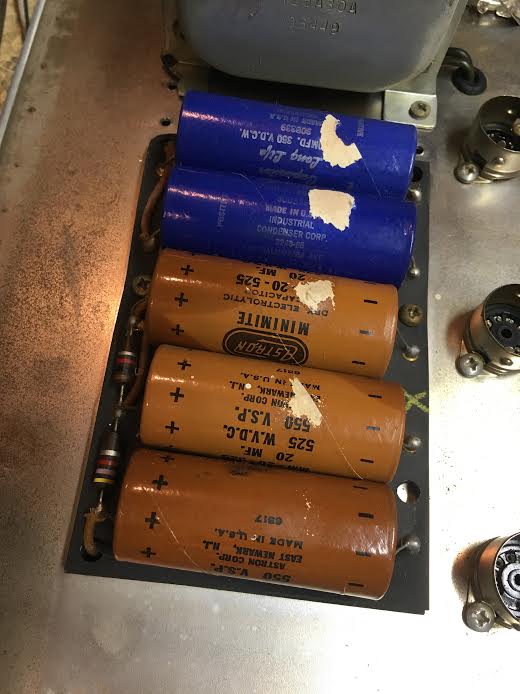
Old caps. It's dumb but on an amp like this I re-use the sleeves cause they have the dates on them. But folks, do change the filter caps. It's just stupid not to!


Did the usual. New grounded cable yadda yadda..... Transformers are all original and this amp is no longer sad and neglected, its cutting tracks once again at Sonic Circus in Vermont!

J

Wednesday, November 2, 2016

1973 Fender Twin Reverb with rare JBL speakers


I played a Twin through high school. They're big, heavy and torture to take around. I'll never forget loading mine up in the back of my dads station wagon one night and he drove me to band practice (a Go Go band called Currency back in 1985!) and we took a corner and heard a crash. I was worried about my precious tubes. In Actuality it took out a window and the amp was just fine.....


About this amp. It's a nice one. This was a custom order one loaded with original JBL speakers and has the original foot switch.....


I'd never choose these speakers myself but when I do hear them I understand why someone would. Clean, big and bright. I actually like them in a black/silver panel Fender amp.

The complaint on this one was muddy sound, noisy intermittent reverb. It had some bad caps, needed a good cleaning, fresh output tubes and a NOS 12AT7 reverb driver tube. Never use a new 12AT7 in this position. They don't last and there are plenty of cheap 12AT7 tubes about....Sylvania, RCA, Telefunken, GE, anything but JJ or Sovtek!

This amp was also literally 7 resistors and 1 capacitor away from the original black panel circuit. I converted it. That's a part of that muddy tone one heard with these early 70's amps. It's worth it. The amp plays with a more open sound. Also re-wire the bias circuit so you can actually bias the amp. Get rid of that 'balance' arrangement.

Silver panel schematic:


Look at the phase inverter. That's where the "silverness" happens. Change it up to:


You may also change the 2 resistors in the power supply, but I prefer to leave those alone. A hair warmer in my experience.

You don't see many of these about here in NYC. Most of us prefer Deluxe Reverbs or Princeton Reverbs for these tiny clubs. So the prices are largely dependent on region. Some places you can get one for a bargain. You can buy one of these hand made amps for the price or less than a new reissue! Leaves me to wonder what the point is in those reissue amps. They are nice, but not quite as nice as one of these. Something to consider......

Idea on value:

https://reverb.com/marketplace?query=fender%20twin%20reverb

One like this with JBL speakers can command a high price, the rest, great amp for the money!

JB

Update on this: Client wanted a fresh set of preamp tubes as well. I'm a "if it ain't broke don't fix it" kind of guy but complied. When you change an entire set of tubes sometimes problems can arise. In this case one did. The tremolo started going 'tick tick tick tick'. No biggie. Simply put a .1 600V capacitor across the neon bulb tremolo 'bug' from the 10 Meg resistor to ground. I have little idea why this works, I'm just glad Jeff Bober showed me this trick 25 years ago! Saved me a lot of time over the years. I watched another tech painfully decline this and his customers Twin just kept coming back to solve the problem. The situation got tense. I told him this but he saw no logic in it understandably but he wouldn't even try it. I wasn't the tech at this shop and knew by suggesting this I was merely causing tension so I backed off. The customer backed off too and went elsewhere.....

Amp sounds great. Those JBL speakers have a richness to them. That's why they work so well for me. Clean but good, complex clean.

Tuesday, October 25, 2016

1976 Fender Super Reverb, end of the good ones.


This came in last week, belongs to a recording studio. The complaint? Harsh distortion at any volume.

First note, just a low E revealed this to be true. I felt annoyed. Sounded like bad voice coils. I did not wish to box up another four speakers and send them to California, not after the last 4x10" amp ('67 Marshall Bluesbreaker combo) had four bad voice coils. Made that telltale "THWACK" sound. Ruh Roh.....

But after opening the amp up I could see one electrical problem. The screen grid resistors were fried. I believe they were 1 watt resistors. Never use less than 2 watt.


After installing them I checked the bias. Each of the Sovtek 5881 WXT tubes were drawing about 4 milliamps. So, I re-biased for 35ma and the amp came to life.

This amp was rebuilt by someone years ago, new caps etc. They also did the black panel Fender mod which is pretty extensive. Worth doing. These amps have nothing really special about them so why keep a rather mushy sounding amp 'original' when it can sound great, and this amp does sound great. It's one of the last of the 45 watt models. They went to 70 watts about a year later. I really don't like those! The 70 watt amps are heavier (these are plenty heavy!) have an ultra linear transformer which I'm not fond of, lacks the power supply choke and no tube rectifier. The result is a harder sounding amp. Okay for country music if you need to play really loud. But for me? I prefer the softer compression a 5U4 or 5AR4 rectifier tube offers. These earlier models just have nice color to the sound, more warmth and more compression when you hit a note at high volume. Amps from this era can be a bargain. Still hand wired, still very high quality and easily modded to be close to the coveted 60's black models.

One more problem was noise. The reverb recovery tube was bad and the 2nd channel preamp tube for volume and tone had a good hum. That part was easy. The first channel had a good amount of snap crackle pop going on. And to make matters worse after replacing the load resistors and cathode cap, it didn't go away, it just became intermittent. Ugh. Some 70's Fender amps I've found the wire to oxidize and go noisy. I really hoped it wasn't that. Not up to replacing wires but if you do find this, start with the anode wires going to pin 1 and 6 on the 12AX7.

Fortunately it wasn't this. I found when it was in full crackle mode if I turned the channel all the way down it was gone (duh!) but also found if I turned the channel all the way up is went away. It only crackled in the middle. So I threw in a brand new CTS 1meg volume pot. Let it play for 2 hours and no noise. It's rare I get a volume pot that does this but I remembered my man Steve at Angela Instruments telling me this back in 1990 or so. Worthy of a try and it worked.

This amp has the original master volume and distortion circuit accessible through a pull switch. If I did the mods I would pull that bullshit out of there! The master volume never really gets dirty enough to justify having it in there, the distortion is comically bad sounding and the extra wires running around add a bit of hum. But like I said, this amp sounds great so if it ain't broke.....

For some ideas on Super Reverb prices, click here:

https://reverb.com/marketplace?query=fender+super+reverb

The 1967-1969 ones are some of my favorites once converted. But even the 1967 black panel amps aren't awfully expensive! You can spend way more on a boutique amp. Heck, I even built one for a client that set him back $1800 initially. He had every ultra expensive component mapped out for the thing. Top of the line Weber speakers, big ass Mercury Magnetics output transformer, every cap and resistor mapped out from years of "research" on internet forums. The result was the only amp I ever built that I didn't like. It was anemic. Another $1000 later it was exactly as I would have built it. Run of the mill Sozo caps, carbon comp resistors, cheap Weber Chicago series speakers, and the amp sounded like an old Super. Really great! And I was was baffled as to why anyone would go to the expense when an original is just not as expensive! Though, I sure appreciated the business, and he was a great client. Learned a lot about cap differences through his OCD tendencies. Literally, he would have me change one cap due to some jive he read on the web, but that one cap did make a difference....

I remember the first Super Reverb I ever heard. It was a Berklee Professor named Jim Kelly who had one and I saw him on a gig. I was floored by his tone. The second was my man David Lyons who now owns Sonic Circus (http://soniccircus.com/) in Vermont. After playing his my "new amp" phase abruptly ended. He had such a lovely sound. I no longer really play gigs big enough to justify using one of these but if I did, these are excellent workhorses. Tough as nails and really cut nicely.

Let's see. One these plus that Bluesbreaker equals 8 ten inch speakers....... Yeah, that's the ticket....

JB

Tuesday, December 1, 2015

'65 Deluxe Reverb Re-issue. This offends me!


 Today we have what I consider to be one of the best values on the marketplace today: a good ol' Fender '65 Deluxe Reverb reissue. Classic design, perfect club amp for those who like the black panel Fender sound. 22 watts of power through a pair of 6V6 tubes. There was a time when if I had a dozen original ones in my store they would be gone in a month. Everyone seemed to want one about 15 years ago. Now the watts war is in reverse and that honor goes to the Princeton Reverb. Those sell effortlessly enough that Fender made a re-issue of those as well. I prefer the Deluxe myself.

  So hopefully my headline got your attention. These are great amps but there are a few things about modern construction that just bum me out. This one was dead, no big deal, just had a burnt 6V6 tube. The fuse didn't pop so the 470 ohm 1 watt screen grid resistor burned up. Again, no big deal.

  In the old amps Fender put the 470 ohm screen resistors on the tube sockets along with the 1.5k grid stop resistors. To cut cost they put these on the circuit board. When one burns up, and it is a dramatic burn, it makes a mess. Here is the socket:


And here are the burnt resistors on the board:


So first step is to cut those resistors out and clean up the board with sandpaper and compressed air. Get as much of that carbon out as you can.


  Next I bypass where the old resistors were. I also bypass R60 & R61, the grid stops. I will be moving those to the sockets as well. Why? They should be on the sockets. They don't always work when they aren't. Why risk that? I've seen it happen before, having them on the board doesn't prevent oscillation at high volumes. Simple fix.


  Now admittedly, I'm cutting a corner here too. The proper way to do this is to remove the board and remove the resistors, then replace them with a solid piece of wire. Do as I say, not as I do. This does add time to the job but we are on a budget and this works just fine.

  Here are the re-wired sockets:


  Notice I moved the orange from pin 4 to 6 and put the 470 ohm, now 2 watt resistor between 4 and 6. I also moved the green wire from 5 to 1 and put nice sounding carbon composition 1.5k 1/2 watt resistors between 1 and 5. This is how they did it in the glory days of amp building.

  Now if a tube blows again, there is less mess to clean. I feel better about the whole thing. Not to mention, if we were to put those screen resistors back there they were, the next time they burn, they will burn a whole through the board most likely, then we'll have a real mess! Prevention is easy on these amps. Do this and save yourself trouble down the road!

JB