I love old tube amps. If you dig them as much as I do, this blog is for you. Guitar, Hi Fi, recording gear, nothing beats the warmth and character of this antiquated technology. Shared here are tips to keep your much loved old amps in good shape, and tips how to improve your new gear. Have a comment or suggestion? Leave it here! Thanks for reading!
Here was a really tedious, un-fun job. Initially it was blowing one of the heater fuses. A mystery since my client said he changed the speakers to nice Blue Bells and it simply quit working. I was hoping for a quick fix and as it turned out it was a simple problem: one of the chassis nuts came loose upon re-assembly and it shorted out the heater.
But then I figured while I'm in here I'll recap the thing. It is 30 years old after all. I'm glad I did. The first two caps were leaking badly so I did them all. The client also wanted me to modify the tremolo and take that stupid 3 position "all of them are too fast" switch out and replace it with a 1 meg pot. Not an easy task, I needed to unsolder the little PC board that has the trem speed and type switches, carefully saw it in half, put the type switch back in and then hard wire a 1 meg pot into place.
Done. Re-assemble.... and...... damn. This thing sucks.. It's un-usable. So much hum, hiss, RF bollocks going on. I remembered hearing about these issues but other than re-tubing a handful in the past this was the first time I've ever really had to sit with one.
It was bad...... really bad.
I recently did some work in two OG AC30's for my man Sonic Dave in Vermont. I undid some sloppy tech work and tidied it up. There's no such thing as a quirk free AC30, they really aren't that good in a lot of ways other than the awesome sound they produce, but both were easy to deal with and had no objectionable hum.
I remember when these Korg reissues first came on the scene. They were touted as the first reliable AC30, which after the nightmare versions of the 70's and 80's, was objectionably true. They are great road dogs. I wouldn't consider taking a real one on the road, they're fragile.
What I find astonishing is how the good people at Korg simply chose to ignore decades of amp building wisdom and, excuse my language here but I'm pissed...... how did the fuck it up so badly?
The entire circuit board is a ground loop to begin with. It needs to be chopped up into 3 sections and that's just the beginning. I'll provide a path to a video from a fine tech for your viewing pleasure and I hope he doesn't mind. I will not show my own work here just like the tech in the video because if you can't understand exactly what he's talking about then you have no business doing this yourself. It's a big job and PC board amps are not like working on a good ol' tweed Champ. Cutting solder traces sounds easier than it looks.
I will give you this piece of information however:
Last night I tossed a coin to see if I should add a hum balance pot on top of everything else. It came up positive 2 outta 3 tosses which means hellyeah!
I'm glad I did. When you turned all three channels down it hummed and buzzed. If you turn up the normal channel that goes away. So I turned them all down and adjusted the hum balance. It's as close to dead quiet as it can possibly be without changing the power transformer which has a mechanical hum.
Anyway, search this on Youtube:
AC30 Comparisons - TB/TBX Hum Fix
The tech says exactly what I say here: do not attempt this unless you have a lot of experience. He was annoyed too. He doesn't like to give away information for free understandably but I'm grateful he did.
So if you buy one of these, buy it CHEAP..... unless said work has been done. Or pay me $600-$900 to get it right. This was an 8 hour job. I like perfect but I'll stop here. Perfect would mean changing the power transformer as well.
How does it sound? Awesome......... No joke. It's an AC30. Now reliable and useable.
This one was fun. I came out of semi amp fixer retirement to tackle this beauty. It's a very early Gibson EH-150 built around 1936.
My client got it a while ago and it's been sitting. So he contacted me with some photos and details and it piqued my interest enough to go for it.
I have a thing for early amplification. This amp is so simple. Other than the two cathode resistors there are no other resistors, not even in the power supply. And other than the two cathode capacitors and the filter can there are no other capacitors, none in the signal chain at all. Instead of coupling capacitors you simply have a driver transformer which has this beautiful copper shield around it.
It's a big piece of iron, around the same size as the output transformer. Rather than having any power supply resistors it has only chokes, one on the field coil speaker and the other inside of the chassis.
The tube compliment is ultra simple: one huge 6A6 tube, which eventually would evolve into the 12AU7, and this drives a pair of 6V6 tubes and it has a 5Y3 rectifier. I'll call this amp version 1B. I know version 1 had an 80 rectifier and 6F6 tubes driven by that lovely 6A6.
I love the tube shields.... GOAT. I mean, come on. It looks like a sarcophagus and it's stamped GOAT!
After inspecting and cleaning the speaker I determined it is okay, which is good since I don't wish to ship it off to be rebuilt. Field coil speakers have a lot of wires..... It had a nasty distortion that was cleaned up by removing the thick layer of 70 years o' dust on the bottom. Sometimes if you are lucky that is all it takes.
Before my client dropped this off he mentioned he had not seen any of these with this knob before. I have strong reason to believe this amp left the factory without a volume pot. That is not all that unusual on such an early amp. I worked on a primitive Gibson like this, link here:
I've also worked on some primitive Rickenbacher amps that were all metal and built with no volume knob. And yes, I spelled Rickenbacher correctly, that is how the name was spelled back then.
So anyway this amp had a peculiar problem. When you turned the thing on it made a high pitched squeal like a bomb falling followed by a loud pop. The squeal would go away if the volume knob was turned all the way up or down, but the pop would come and go and with the pop went a good amount of volume. I tested all of the tubes and they thankfully tested very strong.
So if looked at the next culprit and heated up every ancient solder joint. The two on the driver transformer did need help but that squealing and pop issue did not get resolved.
So issue number three: That volume knob. It's an ancient 500k pot that had a 500k resistor across the wiper and ground terminal. Something looked a little fishy to me, like a cover up..... Then it dawned on me. This is a classic parasitic oscillation issue. I took my plastic chopstick and the squealing increased or decreased by moving the signal wires around. So I replaced the wires with some boss looking Gibson shielded cable for integrity. Most amps I would use Mogami but this one I'd rather use some period correct looking stuff!
I did replace the badly tarnished input jacks as well, they couldn't be saved. When I replaced them I also sanded the chassis and used tooth washers to make sure the ground is tight. I wound up removing that 500k resistor as well, it's not needed now and only robs your signal a bit. I believe it was added to try to tame that oscillation. The kind of thing one does before gaining experience at this. I'm sure I would have tried the same thing at one point if I were pulling my hair out!
So there you have it. Even in an ancient amp lead dress is important. Very important! And while you don't always needed shielded cable sometimes that is what solves the problem.
Now bear with me here. I want to share a story about a modern boutique amp that came across my bench around 2005 or so that had an identical issue. It was a "Cowtipper" model, basically a Fender Twin Reverb in a head clone. I'll just go into it.......
My client, who is someone I count amongst my many friends, bought this thing and had it shipped. When it arrived there was no sound so he called me right away since he was a professional musician and needed this thing to be right. I opened it up and gasped. The no signal problem was easy as pie to track out.... most no signal issues tend to be easy, and in this case it was a resistor that got broken in shipping. It was the 68k input resistor. Why did it get broken? The wire used was that heavy 18 gauge green cloth wire used for heaters. It's solid core and not the least bit flexible. I pointed this out to my client who was reluctant to replace that piece of wire since he was led to believe the manufacturer was some kind of guru who would only use the best part for the job. This is the input wire and it's not shielded. Not a big deal, old Fenders didn't have shielded input wire until the early silver panel amps.....
But then I noticed two more issues. One was the same wire was used in the power supply. It was on the standby switch and UNSOLDERED..... Just a mistake. I've had a white Fender Bandmaster come across the bench with one junction that never had solder in the tremolo circuit and it worked for 40+ years. But that's the tremolo circuit. This was the main power line with 450+ volts sitting there!! It was making contact and well wrapped, it was just never soldered. So I pointed this out and soldered it.
The third thing was this very strange arrangement of the signal wires. One was the input wire which was hot glued to the wire coming off of the volume control (first gain stage). They were wrapped in some kind of foil and hot glued to the top of the tone capacitors. The foil bothered me since it wasn't grounded. It looked sloppy and I wondered why it was there. Was this an attempt to shield it?
So I pointed this out to my client and said "my man, I hate this arrangement. Please let me change it! It's trouble down the road!"
He said no, it's gotta be there for a reason. This guy is like an amp god so don't mess with the tone! The amp was working and sounded like an amp so I left it at that.
He took it home and a few hours later he called me in a panic! "Jef! I have the amp on 10 and my neighbors aren't complaining! It's as loud as an acoustic guitar!" This was an 80 watt amp..... I knew what the problem was right away: PARASITIC OSCILLATION... due to that awful wire arrangement.
My client came by first thing the next morning and I shared my thoughts but he didn't want me to touch it. He said the builder was going to call me that day to "talk me through the process."
Ooh, I was looking forward to that call! But it never came. I looked at that amp collecting dust every day for a week, and never got a call. My client was anxiously calling me daily and was losing faith in his guru. So I got sick of looking at this thing and opened it up one morning and hit that weird wire foil arrangement with a chopstick. BOOM! Louder than I like it. Exactly what I thought. I took all that bullshit wire and tin foil out and installed some shielded cable and called my client. He was thrilled and asked "so he called you???" I said no, he never did but the problem was simple and exactly what I thought.
It was a really good amp after that.....
Moral of the story is, all of this is a learning process. Fender made mistakes, I still make mistakes and whoever did this little Gibson amp made them too. If that builder had called me he might have learned something that day, and I bet this problem didn't show up in 95% of his amps. Lead dress, grounding, these are things that vary from amp to amp. None of it is set in stone. Only experience reveals the solution. Trial and error and being able to admit we don't always get things right.
Oh yeah, how does the EH-150 sound? I think these have a beautiful voice. Very rich and clear. Nothing at all like what one associates small tube amps with: it doesn't distort, rather it sings. I would love to build one but I mean, does anyone make a field coil speaker today? I've yet to meet one I didn't like. They are limited, this isn't an amp I'd use to rage out on, it is one I would use at an acoustic session for low volume situations. That warmth is unbeatable.
This was a fun one. It arrived DOA. It needed the battery clip to be re-soldered which was easy enough but then the fuzz part was barely audible. In this case it just needed a re-cap. These are reaching the half century mark so just do it already!
This is one of the non inductor wah models. I'm not terribly keen on this one myself but it does have it's own special trashiness that would be perfect in the right setting.....
Truthfully, I've yet to meet a Fuzz Wah I love but this one is pretty nasty and much better than many other makes. The octave section on the fuzz really goes there! Ear splitting but somehow has that psychedelic beauty only these old creations capture so eloquently.
In June 2021 my favorite amp was stolen from my van in Brooklyn. I played Russian roulette with my gear many times, it was buried under blankets but on this night I'm pretty sure I was being watched by someone in McCarren Park as I locked my van up for the night.
I discovered the theft on Saturday as I was picking up a friend. I noticed the passenger side door lock had been tampered with. The funny thing was I parked in a no parking zone for two whole days! So naturally I was annoyed but I pretty much accepted the loss. I did file a police report and unlike me I didn't have the serial number. All I had was a good description.... I put the oxblood bakelite knobs on myself and the smooth sky blue pilot light was my addition too.
I was annoyed but what are you going to do? In a city of 10 million folks I'm a very low priority for the NYPD. So, that's the way it goes. I did what I could including posting photos on the social media that I have and I wrote to all of the NYC guitar stores I could think of.
So fast forward to a Friday in December and a good friend in Baltimore texts me with a Reverb listing and he asks me "Is this your amp?"
Yup! I could see my signature on the filter can in the back and it even had the pack of DR Pure Blues strings still in it. The seller didn't seem to know too much about it but he had a years long history and knew that it was a rare amp. I have a feeling he may have seen it on my blog here since I was singing it praises.
His asking price: $2000! Local pickup only.
So all of the emotions came popping up right away. The stuff I didn't really allow myself to feel back in June. Disgust, violation, rage..... I thought about setting up a meet and showing up and just taking it. But I figured at $2,000 it's not going to go anywhere fast!
So I contacted the Greenpoint precinct. I figured that was a long shot and it was. A petty larceny in NYC? The cops literally have more important things to do. They did get back to me on that Monday but by then I had already gotten it back.
How did I do it?
My gut told me the seller was not the thief. So I simply wrote to him and said "Wow, you found my favorite amp! That's amazing! I would like it back now as it was stolen in June."
I did my best to appeal to his higher self and it worked. I presented photos and social media posts in my first message. He pushed back for one half of a sentence then apologized profusely. He bought it at a table sale in east Williamsburg for $40. He showed me the text exchange he had with a friend about his lucky score.
Within an hour of contacting him he dropped it off at Southside Guitars where I work once a month. I paid him that forty bucks as a finder fee and while I know I didn't need to do that since he was selling a stolen good, I was happy to pay him. Why would I do such a thing?
If I had found a cool amp on at a sidewalk sale I would have done exactly the same thing as him. In fact that is part of how I make my living. It's survival. Sometimes you win, sometimes you lose. There is little to no accountability in our eBay Reverb world for hot goods.
When I worked at a shop in Portland two street drug dealers brought in an old saxophone.... I could see it from across the room and knew it was something I could get $2k for. Rare and desirable. The store turned it down so I asked permission if I could buy it. Me and the dealers stepped outside and they told me it plays nice to which I replied "bullshit. I know you don't play so don't try to play me. How much fellas?" They said $40. I took out two Jacksons and sent them on their way.
The horn had been neglected for years. No case, badly tarnished but in good physical shape. I ran it through the Portland Police Department second hand goods three times (I think that was 6-12weeks?) before I had it fixed up to sell. No one seemed to be missing it. I won that time. I could have just as easily lost.......
And I remember the pawn detectives. I think when I started working at that shop the Portland PD had 3 pawn detectives. It was reduced to one soon thereafter.... one moved to Arson and the other was moved elsewhere. That's too big a job for 3 people let alone one.
So for the fella who was trying to sell my amp: Thanks for doing the right thing! It's a good way to live.
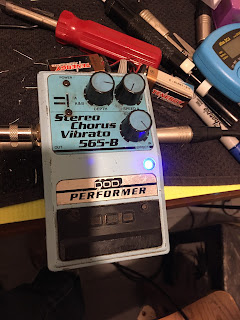
Ok.... another pedal. This one was fun. It belongs to a good friend and it's been with him since the 90's. It came sounding rather weak and with a lot of crackly chunder going on. So I put on "The Gentle Side of John Coltrane and in 4 sides (just over 1 1/2 hours) I re-capped it and cleaned it thoroughly. I also changed the LED as the original was going dim. We went with blue cause... why not??
The re-cap was pretty easy except for the nasty double sided circuit board. But the nice thing is I could remove the whole thing just by disconnecting it!
It's funny. I've never worked on a DOD. Financially speaking I would say no unless you love it. These are still cheap as chips. That being said, once I plugged this in to my two baby Magnatones for that stereo glory I found I love this box! Instant 80's inspiration!
Will I buy one for myself? Doubtful but if I wanted a chorus box this would likely be the one for me!
Got lucky with this one. I've been taking on some pedals at Southside Guitars. I kind of enjoy them.... it's nice when you can find a schematic and even nicer when you can get them to work!
This one is a 1972 Mu-Tron Octave Divider with a cool 70's Miles Davis era ring modulator function. When it arrived it only half functioned (bass only side worked, the rest did nothing!)
I got lucky. I did the routine: changed EVERY electrolytic and tantalum capacitor and cleaned everything thoroughly, touched up the solder joints.
And yes! it came back to life. No IC changes necessary. But then two out of the three LEDs died!!! So I ordered a kit o' LEDs and replaced all of them. It's ready to go cut tracks in your Miles inspired band or EDM or whatever you wanna do! Go on and get your creativity on! If you buy this one it's a good one. Y'all know me, I'm a strong proponent of changing out those electrolytic caps (exceptions are old fuzz boxes that sound like the customer want's them to sound.... gotta wait till those die otherwise you'll get that "but it had this thing before!!)
Funny demo. I don't know what to do with this one!!
This was a fun one. A very nice Park 75 from 1969.
In my 32 years of doing this I've had the pleasure of working on exactly 3 Park amps from the old Marshall 60's plexi era. I did work on a 70's one at some point but that one wasn't as memorable.
The first was a Park 45 a guy brought to me in Portland about 20 years ago. He had just bought it at a pawn shop in Vancouver Washington for $300. A wild man apparently had dropped about a dozen ancient Marshalls there so I dutifully drove there right away and bought several. They were all in various states of dis-repair but little things like, in the Park 45 the slope resistor had been removed.
That amp with it's KT66 tubes left an impression! I wish I was the lucky man who popped in that day.
The second was a Park 150 I bought from a shop in downtown Portland for about $500 or so around the same time. That one didn't thrill me as much but it was pretty fascinating. I recall it being somewhat like a Marshall Major but far more interesting. It had an early "overdrive" channel and was just too much amp for me. Think Ritchie Blackmore. I did like that channel though, more primitive than the few Laney Klipp amps I've seen. That Park didn't stay with me long, I re-capped the power supply and flipped it like a burger.
I do know that Park was built by Marshall, but with subtle circuit changes as to not totally compete with Marshall. The coolest thing about that 150 is there isn't a Marshall like it. He seemed to be in a groovy experimental place building that one.
Then last week this beauty came across my bench.
As far as I could tell, and I didn't bother with too much analysis as it was a "get it ready to sell" job and it was already in well maintained great health, it's just a 50 watt Marshall with KT88 output tubes and different cosmetics. Beautifully built inside and out like a good hand wired Marshall is.
The cabinet is loaded with Celestion "Greenback" speakers and it's a cool bass cabinet. It sounds exactly as one with expect with a good Les Paul: voice of God or Satan depending on what style you dig. Or the voice of good LSD if that's your bag! I'm a big fan of these early Marshall amps. Nothing sounds like an amp pushed to the brink! Master Volume is great as this is too loud for me today but that being said, nothing beats the real thing!
I thought the JJ KT88 tubes that were loaded in this one sounded pretty damned good for modern tubes. Of course I would like to hear it with the OG Genelex glass but.... that's a lotta dough.... Glad these were pleasing. Thumbs up.
This amp already had all of the filter caps replaced in the 90's. No hum, great bottom end, no need to change anything. I like it when they show up like this. In and out in no time at all.
Second box of the day. This one arrive DOA. Someone had boogered it up inside with some shoddy tech work and ya know, why make an EH pedal worse than it already is? These charmingly janky boxes that do a good job of falling apart on their own.
I got this one working by re-wiring the battery cables. The switch was intermittent so I replaced that and it worked brilliantly for about 3 minutes then POOF!
Power supply issue. I needed to replace the 2n4302 FET in the power supply. They are rare and spendy. I first tried a recommended substitute but that failed after 10 minutes. I replaced all of the electrolytic caps with the same values and replaced the tantalum cap with another tantalum. I also replaced the 13v zener diode (this pedal is 18v, takes two 9v batteries.)
I don't find much joy in working on janky pedals but it is nice when there is success and I've learned something.
How is it? It's a two trick pony.... slap back and faster slap back plus blend. That's it. I can do better with just a delay box. However, it sounds wickedly trashy! If I had a studio I would own one of these. I'm not sure there is anything else that quite sounds like this box.....
Ok, I know it's not a tube amp but whatever. It's old, it's vintage and it's effing weirdly kinda cool.
I've received a box of pedals from Southside Guitars in Brooklyn. Pedals are not my idea of a good time but I do like bringing things back from the dead.
This one arrived DOA. If you are lucky that just means a bad battery cable or a bad joint. You should also heat up EVERY solder joint and clean every pot twice minimum. Did that and still nothing.
In this case I needed to change the Optocoupler to get it going. I bought one and the thing made sound but did nothing else than that. I also re-capped the thing, still no effect. I was at a loss as to what to do. So I consulted the interweb and found a guy on the Facebook who had success with one of these. I followed his advice and made my own optocoupler with a white LED and a GL5528 photo sensitive resistor.
(Shout out to Pete's Pedals in St Louis for the help!!)
And, it started to do, erm, something! I needed to re-solder the batter connectors on both ends of the cable and clean the pots once again and now it works. I needed to adjust the little trim pot on the inside to make the LED maximum bright. The cool thing about making your own optocoupler is you can see how that light is actually behaving.
It's a very rare box with good reason..... not much use for a guitar player like me. I can pretty much make my fingers do what this does but I can see one of my analog synth addict friends having a good time with this box. You play it softer and it lets more sound through in one mode. Play it louder and it cuts the volume. That's in Bow mode. Percussion appears to be the opposite. You hit the note hard and it really spikes.
Can't really tell much from my little demo but here we go anyway......
This was a repair amongst many I did for Southside Guitars last month over a marathon 2 day period. Simple amp, somehow it took up more bench time than the rest!
You're looking at a run of the mill used 1965 "Fender Electric Instrument Company" pre-CBS Vibro Champ. Lovely little buggers. The first time I ever played one was at this guys apartment in the 80's in Boston. He used a TS9 Tube Screamer into it to record my guitar tracks when I was a Berklee student. I was pretty floored at how good it sounded. I think he had a reel to reel or one of those cassette 4 track machines we all had in those days, the Fostex X15 or Tascam something or another.
Anyway. This one had very little volume. I popped the chassis and, well, you tell me what you see:
Yeah. Seriously. What the eff? That nice bit of lamp cord poorly soldered between the input of the volume knob directly to the 15k midrange resistor which goes to ground. So where you want to see up to 250k between you and ground, you get 15k maximum. I just don't understand what they were trying to achieve here! Did they put it together and say "Yeah, now that's the ticket to Hollywood baby?"
Why didn't they just undo it? Ugh......
That was the first thing to take care of and while it helped tremendously, there were plenty of other bugs.
Always start from the back and go forward. The speaker was an old alnico full range 8 ohm job with a whizzer cone. That wasn't helping any so I just threw in what we had that day, a reissue 4 ohm used Jensen Alnico speaker. That helped but still, meh.... blah.... lackluster. No bass at all.
They had replaced every single signal capacitor with used / leaky weak caps that were also the wrong values. I used Mallory 150s and if you notice, I grounded the amp and used the .047 "Death Cap" at the midrange capacitor cuz, why not? Reduce reuse recycle! And those never go bad and have a special sound.
I also replaced the tremolo caps with fresh ones as that was super weak and they had some weird stuff going on in there too.
But still, no bass and pretty sad tremolo.
Cathode caps..... no bass, sad tremolo. Tremolo is just an LFO right? Better have fresh cathode caps to get it strong. In fact, just replace them already! This amp is 56 years old now.
After that I still wasn't happy though. Tremolo was working albeit, just not awesome, and the bass would vanish when you turned the treble up. Weird......
So upon closer inspection I noticed the tremolo intensity pot was dated 1966, but no indication of the ohms. They always say 25K RA. So I pulled it and measured the thing. 500k. WRONG!
I dropped in a 50k pot since that was all I had on the shelf. Those 25K reverse audio pots are hard to find. The 50k pot isn't correct but it did make the tremolo work better. With the 500k pot there was almost no tremolo until you got up to about 8. So, while not satisfied this would work. I could also bypass it with a 47k resistor to make a fake 25k pot. I don't like doing this but in a pinch it does work and only the rabid amp fanatic can usually tell.
But that treble control bit was really driving me bananas. The amp still seemed weak too. So I then figured if the Bozo that modded this amp changed that tremolo pot to something so wack, maybe they changed a tone pot.
They didn't. The tone pots are the original 250kA pots dated 1965.
So I checked the volume pot. Lo and behold, it was the 25K RA Intensity pot I needed! Captain "Wha? TechNo No No" used the 25k pot and scrapped the 1Meg pot that was in there. I took that 25kRA pot and put it where it belonged and threw in a new CTS 1 Meg volume pot.
Now we're cooking with grease...... GREAT tremolo and GREAT tone!
The power transformer was replaced sometime in the 70's with the correct part. I did clean up the wiring there too. Come on folks, twist those AC lines already!!
In conclusion. I do not know what this person was trying to achieve with the mods they did. If they were trying to make the amp play with little volume, why not just turn the volume knob down? I imagine they may have been trying to get more tremolo so they used that 500k pot. Nope!
If you do not know what you are doing then please consult someone! Otherwise a fella like myself can spend hours undoing your ill conceived ideas. Seriously, ask. Most of us are happy to share information....
This is from the pile o' bigass amps at Southside Guitars.
Not going to get all technical, nothing new to write. I just wanted to share some photos of this behemoth!
This was a "just get it going" job. It didn't take much. I just replaced the electrolytic caps. Fortunately that quartet of beautiful GE 6L6 tubes was in great shape. Most of the preamp tubes were good too. I replaced the first stage filter caps and one of the new ones was bad! 120 cycle hum and low b+ voltage around 380 or so. Good indicator it's the first stage. Replaced it and voila.
How are these amps? They're like a janky ass Fender that looks soooooo glam. Made well enough and not one bit better! I've worked on many including the "Earth" amp series built later. They were made in NYC. This one boast a 2x15" cabinet. I cannot imagine anyone in 2021 being interested in hauling one to play in sad backroom gigs where they have no chairs but 200000 watt PA systems that sound stellar, but please, someone start a band with these as the backline so we can see a real film, no filter photo!
Tremolo and reverb are good and lush. Get yerself a fuzz box and a wah wah and write yourself the ticket to the sun baby!
The hardest part about working on these amps is getting the chassis out of the head box. There's literally no room at all! I always wind up pulling the power tubes out then taking a dead blow hammer to knock out a piece of wood that holds the back grill in place cause it is dead in the way of your power transformer!
So if you come across one, re-cap it, bias it and test test test it before you put it back in the box. It's like a forest grows around the damned thing minutes after you box it up and if something is wrong, a gotta open it back up again!!
Go big kids! You have strong backs still!!! And big amps are kinda cheap these days!!!
Just had a day servicing two huge amplifiers made in the day of, well, huge amplifiers.
This may easily be the coolest amp I've ever seen from Ampeg:
I believe this may have been a custom order. It's a later model, with 7027 tubes rather than 6L6, and a 7199 driver tube. Grid bias, 5AR4 rectifier and those lovely 6SL7 preamp tubes. The tweeters are a cosmetic addition having never been hooked up.
Not going to get into anything technical, I just wanted to share this behemoth with y'all.
The cabinet has that ultra cool Austin Powers era cosmetics. I have a friend who has a single 15" version as well. Big amps really are no longer in vogue in NYC. This one was on the Reverb cheap as chips and still sitting there. Today the world is about small amps and efficient PA systems. I mean, who wants to move a refrigerator every time you have a gig?
That being said, if I owned a little coffee / wine shack where I featured jazz and folk music, it would be kinda against the law not to own this and stick it in the corner next to the house Slingerland drum kit.
One interior shot:
I did grow up in the last age of the big amp. I used to play a Marshall half myself. Can't say I miss moving these things but, damn. Nothing sounds or looks as cool as that oversized backline!
Hi all. About 2 weeks ago my favorite little amp was stolen from me. The photos here are from about 5 years ago and it's more beat up now. I also replaced the knobs and the pilot light which it sky blue, smooth glass.
Any info would be much appreciated. I've filed a report with the NYPD......
Today I got to see a stunning piece of history. This Bronson amp dated 1949, still with the original shipping box. It spent some of it's life in New Mexico at the Aloha Conservatory of Music. Apparently this school was affiliated with the Bronson brand. I would love to know more! American musical instrument manufacturing is a fascinating subject for me. Especially when it is tied to schools.
Nothing to really write here, the amp isn't NOS, but it's as clean as one can be for a 72 year old amplifier. The customer wants to use it so sadly I needed to change every capacitor in the house. All of the wax caps were leaking badly (yes even with little use, they likely leaked right out of the Valco factory!). And I also replaced the electrolytic caps and the power cable at the customers request. Easy job. These are so well made.
So the insides are all "before" pictures for your amusement.
How does it sound? We happen to have a lovely old Kalamazoo model A with a real Charlie Christian pickup. Lovely combo. I'm a fan of a good field coil speaker which this has. Nice low end.
The filter cans are as follows: 40uf (big for the time!) and a dual 10uf can for the preamp and screens.
Tubes are 5Y3, 6V6 pair, 6SC7 phase inverter and 6J7 pentode for the preamp. I'm a big fan of this arrangement having built a few amps with a 6SJ7 preamp into a 12AX7 or 6SL7 phase inverter. Big, warm sound with nice low end.
Valco knew how to build a good amp. This thing runs pretty quiet. And it's a nice thing to look at. Easy on the eyes. An amp should be able to double as furniture so it doesn't get stuck in the closet when not being used. Potted plants should go near it alone with your sofa. These manufacturers had style back then. Not an ugly rock box or just some industrial looking thing that belongs in the garage. This is something you want to relax with and play some sweet music through.