Showing posts with label vintage fender. Show all posts

Monday, March 29, 2021

1964 Fender Deluxe Reverb. Re-capped but still too much hum. What can I do?

 Here's the desert island amp for many of us and I think after all these years I'm one to be on that island myself. A really clean 1964 Fender Deluxe Reverb. 


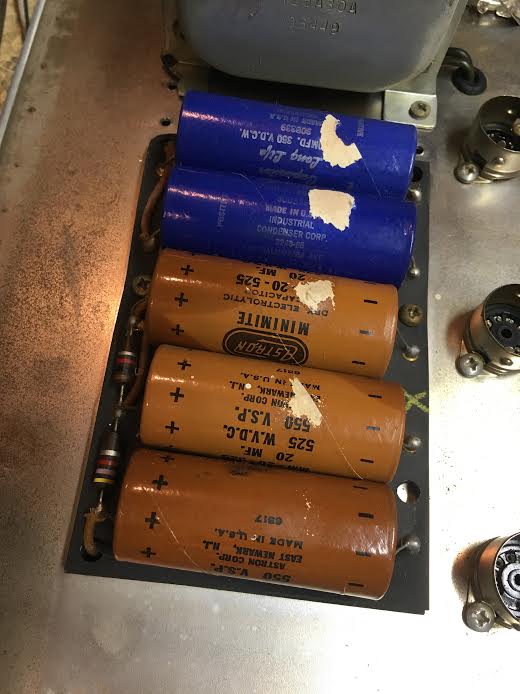
About the amp: Transformers are original, speaker was replaced with a Celestion G12M greenback 30 watt. I'm a fan.... Amp was re-capped well enough. All of the electrolytic caps were top shelf expensive Sprague Atoms. Some of the work wasn't exactly tidy but done well enough.

But, I just didn't like the amount of hum I was still getting. I right away saw some things to improve. First is the bias supply cap:


Whoever re-capped this amp went with the original value. I mean, why wouldn't you. That's what Fender used in 1964 so.... 

Nah. When I worked for Jeff Bober in 1994 he just told me to upgrade it to 100@100v rather than 25@50v. I've been doing it ever since. Better regulation and less hum. I do not detect any change to the sound of the amp and I have well trained ears. And for what it's worth Fender upped it later to 70uf then 100uf cause they could. Caps got a little better. So just do it. If you think that's blasphemy try it anyway and put the old value back in if it freaks you out.

Yup, being dramatic here but I'll share a story. I once had a client who paid me to convert an AB165 Bassman to an AA864. That's no small task. Big job. I made one mistake and one executive decision. He took the amp home and inspected the work under a microscope. The next day I had an irate customer who brought his amp back and he (understandably) expressed his trust had been burnt. So I gladly changed the one pot value that I missed to the correct one. But he was really upset about my little executive choice: using a 100@100v for the bias supply. I explained to him why I did this: with a 25@50v cap it will hum. He didn't believe me one bit and I could tell I was losing his business.

So we gave it a listen, I then replaced it with a 25uf cap.... HUM! And not a teeny tiny difference. It was significant enough that he heard it and looked a bit embarrassed. He asked me if it would make a tonal difference and I said no but if he thinks it does bring it back in a week. I put my little 100uf cap back in, fired it up and he was happy with the quiet. I never saw him again. All is well that ends well!

So here ya go. Use a pretty blue Philips Vishay cap if you will! I like them cause they look nice and European:


But wait! We're not done yet. Amp was much improved but I still wasn't 100% satisfied. This next part involves the signal caps.

If you have been inside as many old Fender and other high quality amps you'll notice even the signal caps have a direction. No they're technically not polarized like an electrolytic cap is, but there is a direction you want them to go in. The have an inside foil and an outside foil. Some old caps like my favorite Ajax blue capacitors you find in Fender amps even tell you which side is the outside foil.

Rule of thumb: always have the outside foil closer to ground. In other words, if one side of the cap is on the 100k plate load resistor and the other is connected to the 1Meg volume pot, outside foil goes on the 100k resistor. Fender almost always got that right! I've only seen a few exceptions. 

Another example is the tone stack. The .1 bass cap goes to a 250k pot and the .047 mid cap goes to a 6.8k resistor. On the other side is the 100k slope resistor then the 100k plate load resistor for a total of 200k. So the bass cap should have the outside foil attached to that slope resistor and the mid cap should be going the opposite direction with the outside foil connected to the 6.8k resistor on the bass cap. Like this:


The phase inverter has three .1 caps. Two are connected to the plates of the 12AT7 while the third is connected to the grid. On the plate load side you have a 100k and an 82k resistor going to each plate. On the other side you have two 220k resistors going to the bias supply. So the outside foil goes to the plates, inside to those 220k resistors. The third cap however is connected to a 1meg resistor on one side and a 47 ohm resistor going right to ground on the other side. So that cap goes in the opposite direction. In this case the previous owner used my least favorite cap, the Sprague 715P. No indication for inside or outside foil so you just read it from left to right. It will look like this:


Notice how the print is going in the opposite direction.........

Here's the dry channel tone stack. I had a spare old polyester orange drop cap that has a stripe on it for outside foil. The mid cap you'll notice reads left to right with the left going to the 6.8k resistor. If you are experienced you'll notice the .047 600v blue Ajax cap for the final stage. Sadly entire channel was orange dropped. But I have a bag of .047 Fender "Death Caps" from the AC balance. I never throw these out when I ground an amp. I save them for classy amps like this one!


One cap backwards will not make all that much of a difference but in this case I counted 5. It adds up. In the hundreds of old Gibson and Fender guitars I've seen over the years, the tone caps are almost always done in this arrangement: outside foil to ground. If the good people at those companies were sticklers for such a detail on the treble bleed cap, there's something to it.


So there you have it. The amp behaves like my own '69 model now. Quiet! Of course it's not possible to eliminate all hum and noise but it is possible to reduce it using these little steps. And the less noise the more music dig?!


Thanks for reading, hope this was helpful and feel free to leave a comment of ask a question below! J




Wednesday, December 30, 2020

1963 Fender Bandmaster, tremolo issue. And, how to slow that tremolo down

 Today was fun. 3 silver panel Fenders and a blonde. All of them were a hot mess of craptastic tech work! Poor soldering, poor choice of components, general laziness.


The best was this 1963 Bandmaster......


These are one of my all time favorites. They're genuinely weird amps in the Fender canon. With active tone controls that people largely rejected and that lush absolutely glorious 3 tube harmonic vibrato that was likely quite expensive to produce. It sounds closer to a Univibe than what any other Fender produces. It's got a phase shifter quality. Not like the pitch bending Magnatone, it's just a shade subtler. 

These amps used to be cheap as chips. Not any more, yet they aren't all that popular. People prefer the tweed and black series, these are just, odd. I bought one for $300 in 1991 and played it with a JTM45 together during the Grunge Scare of the early 90's. Big tone!

So this one was a mess. Just general poor tech work on the inside. It was re-capped years ago. I re-did the electrolytics. The whole thing was Orange Dropped. Not my favorite but since I was on a budget I let them be. Besides, most of them were the old polyester series which I like very much. Only a few were the 715 series.

The choke and output transformers are replacements, the choke being from 1966 and the output transformer is from 1972. Not the least bit unusual on this model. I've seen more Bandmasters throughout the whole range that had bad output transformers and a handful with bad chokes. I think they were just a hair under rated, but that's part of what gives a Bandmaster it's special sound. These parts were likely replaced years ago as this amp has been around the country making music. It's had a life and a half!

So once I got the basics done I noticed the obnoxious "thump thump thump thump thump" of the vibrato system hadn't gotten any better. Simple fix. One of the cathode bypass caps in the circuit was supposed to be a 2uf cap. Someone upped that to a 10uf cap. The tremolo circuit in any amp can be very sensitive so it's best to go with the original component values. Problem was solved right away.

Sometime it's a bad tube that causes this, or a bad cap or resistor. Today I was lucky. No time tied up in trouble shooting mode.

But..... while I love the tone quality of the vibrato in these amps I wasn't satisfied. It was just to fast. Not enough range. Rather boring. Simple mod took care of that.

Locate the 3 caps in series that create the oscillation. On the plate its .02, the other two are .01. I simply doubled the 3rd cap by placing another .01 cap in parallel to the one connected to ground. First try it out:


You can try different cap values here and if you like it cut those leads and give it a permanent home:


Not a bad idea to do it this way rather than replace the original component so if down the road you want to remove it there ya go!

Anyhow, this one is making music again and is for sale at Southside Guitars here in Brooklyn. It's a fantastic amp. Player grade yes, but you're a player right?

JB


Tuesday, November 20, 2018

1965 Fender Showman amplifier. Killer bass or guitar head.

When I was in high school I had a cousin named Bryan. He had issues with telling the truth. But while I didn't trust him I loved the cat anyway. He wasn't a blood relative, just my god brother.

One day he showed up to my house with a Fender Showman, property of the Baltimore City Public School system. Yeah, he stole it.

But whatever. I'm sure they didn't notice it. The amp was missing tubes, badly neglected much like Bryan and that school system. It just needed help.

I was fascinated with the thing. I just wanted to get it working. I opened it up and shocked the hell out of myself on the still charged filter caps. It had power just no sound.

So I found a few tubes for it at Radio Shack and got some resistors that matched. I'm not sure if I even knew what a resistor was in those days. One just was burnt so I had to match it. Yes, Radio Shack in the Columbia Mall sold tubes! Good tubes. Not the crap made today.

I got it working. I remember it sounding like it was underwater, not in a bad way, it was just so warm.

Thus started my fascination with tube amps. And my fascination with the Fender Showman. I think I traded that chassis in on something I bought at Angela Instruments a couple years later. Early on when Steve had his shop in Savage Mill, or maybe in his house. Those were the days!

I did buy a working one when I was in Berklee. I used it for a while. I think I was fascinated as well cause a Marshall Plexi was intimidating to me. A Marshall seemed like an exotic nuclear power source. Yet, when I watched Jimi play Monterrey in the film, he had his Marshall and a glorious Showman amp too. Seemed more manageable to me.

So this one was from Indigo Ranch and had been sitting neglected for a couple or more decades. Simple re-cap, re-tube and there you go. I replace the (either 500pf or .1000pf) cap that feeds the phase inverter with a .002-.005. We're using the amp for a clean 80 watt bass amp. The Showman is 8 ohms, whereas the dual Showman is 4. I prefer these.

Such a beautiful sound......


Old caps. It's dumb but on an amp like this I re-use the sleeves cause they have the dates on them. But folks, do change the filter caps. It's just stupid not to!


Did the usual. New grounded cable yadda yadda..... Transformers are all original and this amp is no longer sad and neglected, its cutting tracks once again at Sonic Circus in Vermont!

J

Thursday, October 5, 2017

StayTrem Jazzmaster/Jaguar bridge. Nice!

Just installed one of these today:


British made StayTrem Jazzmaster bridge. This was installed on a Made in Mexico "60's Jazzmaster" by Fender. The correct radius is 7.25". Make sure you don't get the 9.5" one for your Mexican, Japanese or American reissue guitar or your vintage one. It won't work!

My impressions? This is a great product! Super easy to install and the radius is spot on. I may buy one for my '58 myself. I've never had such an easy time setting up a Jazzmaster.

The slots are nice and deep, you can strum nice and hard without the strings popping out. The tone got stronger instantly too.

The big improvement is the string spacing. This is why I'd consider one myself. Mine has custom made brass Mustang style saddles:


Now look at these 2 photos and you'll see quite easily the strings on the StayTrem don't fly over the edge of your fretboard. First mine:


Next, theirs:


Now, I'm so used to mine that it doesn't bug me a bit. But if it bugs you, this bridge is a great solution to a few problems. Better stability, better tone, better sustain and better playability.

Do consider one! I'm a certified Jazzmaster fanatic and it gets a big thumbs up!


One more improvement......

Jazzmasters can gobble strings. Particularly the skinny E and B. I solder the ends on them cause they tend to unravel. Easy and quick trick I learned from Stevie Ray Vaughn's tech in an article about him. I haven't broken a string on mine in a long time and I'm a brute!


JB


Thursday, September 28, 2017

1958 Fender Jazzmaster. So....good......

I only have one old Fender left, it stays cause I know I cannot do better. It's my 1958 Jazzmaster.


The story of this guitar? How did it come into my life?

I moved to Portland, Oregon from Baltimore in 1995. One of the first people I befriended there is my friend Ben who now owns Southside Guitars with his brother Sam. He was a college student and I was a Baltimore ex-pat starting a new life. We both liked the same music. The previous generation grew up on Stratocasters and Les Pauls, their heroes were Clapton and, well, Clapton. Okay, Jimmy Page too. Our heroes were Sonic Youth, Elvis Costello, J. Mascis, PJ harvey, Robert Smith, Tom Verlaine etc. The music that was anti-establishment before if became establishment like any other art form. The Jazzmaster symbolized this. I was for all intents and purposes, a bit of a failure. Few jazz players dug it (I've seen one and another who played a Bass VI with guitar strings!) but the surfers dug it. Lawrence Welks guitarist Buddy Merrill (badass!) enjoyed one for a time as well.


And in todays world:


Ok, I grew up on Jimi. Played a Stratocaster myself for years until about 1991 when I bought my first Jazzmaster, a 1964 Sunburst model for $750 in Catonsville, now owned by my friend Peter Holstrom. And I was a bit motivated by this intriguing photo:


That's the young Jimi rocking out with Little Richard on a '64 much like mine. Kinda had to have one. Part of my struggle was as a Jimi head I couldn't find my own voice on a Stratocaster. I knew I was a Fender boy but needed to break from that. I played some Jazzmasters back when they were $200 guitars and already liked them. They were weird and funky with an odd sound. There were things I didn't like though, they were a bit bright for me and that sad bridge always went out of adjustment.

But I also liked that is was an outsiders guitar. When I took to my first one someone actually chided me for playing 'that hipster faggot guitar'. I fucking loved that comment from a guitar bigot! I knew I was on a better path. Keep going..!

So back to Ben and Portland. Ben was as much of a fan of the Jazzmaster as I. He was buying and selling guitars out of the trunk of his old Dodge Dart. We bonded over guitars and cars fast. He spoke of this 1958 Jazzmaster in a pawn shop that he was trying to get the money together to buy. It was $900. I had about $57 to my name at this point, just started my job at Denny's Music, so the point was moot for me. And alas, someone else got it. Gone..... Oh well, it happens. And this was before the internet was such a thing. To find another first year Jazzmaster? Much more difficult than it is today with Reverb, EBay and GBase.

So fast forward about 6 years. This dour looking young man who was a regular customer comes into the shop I'm working at with an abused old Jazzmaster. It had humbuckers, Schaller tuners, a black plastic pickguard, tune-o-matic bridge and the finish on the body was stripped and lacquered in natural. He fit the Jazzmaster player type: a bit too serious, black dyed hair, black jeans, his hair drooped over his face. Goth, My Bloody Valentine shoe gaze goddess / god type. He never smiled, kinda grunted and was all of about 24 years old. He needed a setup.

I took the guitar apart and saw the body and neck date, 1958. So I called him and asked if he bought this for $900 out of a Pawnshop back in 1995. Yes indeed. I also told him "I have a set of proper pickups and a proper bridge if you want. He said go for it. After putting that together I took a shine to his guitar. I really liked the thing.

He was grateful that I made the thing nicer and smiled when he picked it up. I said to him "I really like your guitar, if you ever want to trade it for something else this is the place." He said "Thanks, I'll consider that."

In the following months he came around to buy strings and try pedals. His vibe was changing. His hair went from black to brown, down to up, the jeans went from black to blue, the cuffs from short to too long but neatly rolled up, his face from sour to smiles..... he was a good player.... he was also transforming into a rockabilly player. Portland has a big scene for that with the greasy hair, tattoos and big old cars. This guitar was to be mine. It was destiny.

So one day he walks in with the guitar and says "I want that Gretsch Tennesseean!" I said "SWAP!"

But still wasn't convinced and as a guitar store employee with no idea how to save money was still broke. I could trade but wasn't ready to give up my '64 Jazzmaster or my beloved $750 '69 Maple Cap Jimi Gilmour Strat:


Nope. Either may be a mistake. The worst part of being a human can be making a decision. So we put it up on the wall in it's ugly condition for $1800. This was about 2001.

We got calls on it. All questions were about the neck and the neck alone. I was paranoid about this. There was a guy in Portland named Cohn Rude that bought old Jazzmasters and shaved the necks down, put them and as many old parts on a Wood'n Body that he put dowel and nail holes on and would sell them as the real deal with "Parts changed". By my estimation he butchered over 100 old Jazzmasters this way. He did have a family to feed and I actually liked the cat, but didn't like what he did. And seeing as a Stratocaster was an iconic guitar loved by the older blues guys whereas the Jazzmaster was seen as a dog by the guys with money, it felt like a personal assault. Mr. Rude wasn't the only guy calling us, he wasn't the only guy doing this. I even asked one lady "Are you making a Strat?" to which she replied gleefully "Yes!" I hung up on her.

But I can't buy a guitar just to save it. This one was not in the best shape. So maybe it doesn't matter.

One day a client came in and wanted our Japan made Boss DS-1 pedal. He had cash and an original Gold Anodized Jazzmaster pickguard to trade for it. SWAP! I put the pickguard on and the whole thing came to life. I traded my '64 straight across for it.

We had a set of old DuoSonic tuners for it so I installed those. I know they aren't "correct" but I like the plastic buttons on my guitar. I think it looks cool.

I had the body re-finished by a great Luthier in Portland, the best. I won't say who cause he doesn't do re-finishing for anyone, he just did it for me cause we have a great relationship.


Much of the red has faded on the front. Red is an unstable dye. The sun takes it away.


The bridge saddles. Terrible. Use Mustang Saddles or buy a Staytrem or Mastery Bridge. That's the difference between a guitar you want to play and one that you are constantly frustrated by. My vote is for the Staytrem cause they look Jet Age, not Iphone Age.

http://staytrem.com/Jaguar-/-Jazzmaster-bridge-725

But I've also installed the Mastery and they do work fantastic. Good for those concerned about the future:

https://masterybridge.com/bridges/offset-bridge/

Me? A cat named Eric Patton in Portland was making these lovely saddles in Brass, titanium and bakelite. He gave me his brass prototypes:


He built some for Johnny Marr as well. They had a thing going developing parts and all, but they were too time consuming to produce. So it makes my guitar all the more personal to me.

So yes, my guitar is a bit of a parts caster. Like I said, Fender guitars are the Lego of the guitar world.

One other change I made. There is a 'plinkyness' to the way a Jazzmaster sounds. Too bright and unfocused for me. It has a tendency to get washed out on stage. Some old bands I was in preferred the sound of my Strat or Telecaster right away. I agreed. The Jazzmaster is difficult. The solution? I changed the pots from those 1 meg pots to 300K. That seems to be the sweet spot for me. Everything got warmer and less harsh. I know that's taboo to do to a vintage guitar, but try it and save the parts if you don't like it. I play and gig. I need my stuff to work for me. It's a tool at the end of the day, a beautiful tool but nonetheless nothing more than a tool.

More pics:


So that's my story. I always wonder who owned this guitar back when it was new? What hippy stripped the finish in the 70's? Did they like natural foods and play good jam band rock? Did the first buyer play jazz? Surf? Soul music (these are STELLAR guitars for soul, R&B)? How many owners? I only know me and the Bloody Valentine Kid. One day I'll be gone and the story will continue. Will someone appreciate is as it is or part it out for cash? Will vintage guitars be a thing at all in 20 years? Will this generation care? A collector would snub this beloved guitar. Will their be such a thing in the future?

Everything is temporary. That is a beautiful thing.

JB